20 March 2015

Excerpts from State of Georgia Constitutions over the years

The Piedmont Chronicles 

~ est. 2010 ~


- From the original 1777 document. Do you know the eight original counties?

Article IV. The representation shall be divided in the following manner: ten members from each county, as is hereinafter directed, except the county of Liberty, which contains three parishes, and that shall be allowed fourteen.
The ceded lands north of Ogechee shall be one county, and known by the name of Wilkes.
The Parish of Saint Paul shall be another county, and known by the name of Richmond.
The Parish of Saint George shall be another county, and known by the name of Burke.
The Parish of Saint Matthew, and the upper part of Saint Philip, above Canouchee, shall be another county, and known by the name of Effingham.
The Parish of Christ Church, and the lower part of Saint Philip, below Canouchee, shall be another county, and known by the name of Chatham.
The Parishes of Saint John, Saint Andrew, and Saint James shall be another county, and known by the name of Liberty.
The Parishes of Saint David and Saint Patrick shall be another county, and known by the name of Glynn.
The Parishes of Saint Thomas and Saint Mary shall be another county, and known by the name of Camden.
The port and town of Savannah shall be allowed four members to represent their trade.
The port and town of Sunbury shall be allowed two members to represent their trade.
Article V. The two counties of Glynn and Camden shall have one representative each, and also they, and all other counties that may hereafter be laid out by the house of assembly, shall be under the following regulations, viz: at their first institution each county shall have one member, provided the inhabitants of the aid county shall have ten electors; and if thirty, they shall have two, if forty, three; if fifty, four; if eighty, six; if a hundred and upward, ten; at which time two executive councillors shall be chosen from them, as is directed for the other counties.

- Also from the 1777 document:
 Article LXII. No clergyman of any denomination shall be allowed a seat in the legislature.


- The very beginning of the 1945 Constitution:
 PREAMBLE

To perpetuate the principles of free government, insure justice to all, preserve peace, promote the interest and happiness of the citizens, and transmit to posterity the enjoyment of liberty, we, the people of Georgia, relying upon the protection and guidance of Almighty God, do ordain and establish this Constitution.
ARTICLE I.

BILL OF RIGHTS.

SECTION I.

Paragraph I. Origin and Foundation of Government. All government, of right, originates with the people, is founded upon their will only, and is instituted solely for the good of the whole. Public officers are the trustees and servants of the people, and at all times, amenable to them.
Paragraph II. Protection the Duty of Government. Protection to person and property is the paramount duty of government, and shall be impartial and complete.
Paragraph III. Life, Liberty, and Property. No person shall be deprived of life, liberty, or property, except by due process of law.

- Interesting, and relatively unknown, parts of the 1976 edition:
SECTION XI.
MILITIA

Paragraph I. Organization of Militia. A well regulated militia being essential to the peace and security of the State, the General Assembly shall have authority to provide by law how the militia of this State shall be organized, officered, trained, armed and equipped; and of whom it shall consist.
Paragraph II. Volunteers. The General Assembly shall have power to authorize the formation of volunteer companies, and to provide for their organization into
battalions, regiments, brigades, divisions, and corps, with such restrictions as may be prescribed by law, and shall have authority to arm and equip the same.
Paragraph III. Pay of Militia and Volunteers. The officers and men of the militia and volunteer forces shall not be entitled to receive any pay, rations, or emoluments, when not in active service by authority of the State.
Paragraph IV. Discipline of the Militia. When not in Federal service the discipline of members of the Militia shall be in accordance with the applicable provisions of the Constitution and laws of the United States, Acts of the General Assembly, and directives of the Governor in his capacity as Commander-in-Chief of the Militia. Notwithstanding any other provisions of this Constitution, the General Assembly shall have the authority to provide for trial by courts-martial and non-judicial punishment of members of the Militia, for the initiation of charges and subsequent procedures thereon, rules of evidence, venue, and all other matters necessary and proper for the maintenance of a well regulated and disciplined Militia.

- and then also this in re the Judicial Branch. Also from 1976:

SECTION VII.
JUSTICES OF THE PEACE

Paragraph I. Number and Term of office. Unless it has been otherwise provided by the General Assembly, there shall be in each militia district one justice of the peace, whose official term, except when elected to fill an unexpired term, shall be for four years: Provided, however, that the General Assembly may, in its discretion, abolish justice courts and the office of justice of the peace and of notary public ex-officio justice of the peace in any city of this State having a population of over twenty thousand, and establish in lieu thereof such court or courts or system of courts as the General Assembly may, in its discretion, deem necessary, conferring upon such new court or courts or system of courts, when so established, the jurisdiction as to subject
matter now exercised by justice courts and by justices of the peace and notaries public ex-officio justices of the peace together with such additional jurisdiction, either as to amount or subject matter, as may be provided by law, whereof some other court has not exclusive jurisdiction under this Constitution; together with such provision as to rules and procedure in such courts, and as to new trials and the correction of errors in and by said courts, and with such further provision for the correction of errors by the Superior Court, or Court of Appeals, or the Supreme Court, as the General Assembly may, from time to time, in its discretion, provide or authorize. Any court so established shall not be subject to the rules of uniformity laid down in Paragraph I of Section IX of Article VI of the Constitution of Georgia: Provided, however, that the General Assembly may, in its discretion, abolish justice courts and the office of justice of the peace and notary public ex-officio justice of the peace in any county in this State having within its borders a city having a population of over twenty thousand, and as well in the County of Glynn, and establish in lieu thereof such court or courts or system of courts as the General Assembly may, in its discretion, deem necessary; or conferring upon existing courts, by extension of their jurisdiction as to subject matter now exercised by justice courts and by justices of the peace and notaries public ex-officio justices of the peace; together with such additional jurisdiction, either as to amount or to subject matter, as may be provided by law, whereof some other court has not exclusive jurisdiction under this Constitution; together also with such provisions as to rules and procedure in such courts and as to new trials and the correction of errors in and by said courts, and with such further provision for the correction of errors by the Superior Court or the Court of Appeals or the Supreme Court as the General Assembly may, from time to time, in its discretion, provide or authorize. The civil court of Fulton County shall have jurisdiction in Fulton County and outside the city limits of Atlanta either concurrently with, or supplemental to, or in lieu of justice courts, as may be now or hereafter provided by law. Any court so established shall not be subject to the rules of uniformity laid down in Paragraph I of Section IX of Article VI of the Constitution of Georgia.
Paragraph II. Jurisdiction. Justices of the peace shall have jurisdiction in all civil cases arising ex contractu and in cases of injury or damage to and conversion of personal property, when the principal sum does not exceed two hundred dollars, and shall sit monthly at fixed times and places but in all cases there may be an appeal to a jury in said court, or an appeal to the Superior Court under such regulations as may be prescribed by law.
Paragraph III. Elections and Commissions. Justices of the peace shall be elected by the legal voters in their respective districts, and shall be commissioned by the Governor. They shall be removable on conviction for malpractice in office.

SECTION VIII.
NOTARIES PUBLIC

Paragraph I. Appointment; Number; Term; Removal. Commissioned notaries public, not to exceed one for each militia district, may be appointed by the judges of the superior courts in their respective circuits, upon recommendation of the grand juries of the several counties. They shall be commissioned by the Governor for the term of four years and shall be ex-officio justices of the peace, and shall be removable on conviction for malpractice in office.

`MM

18 March 2015

Sweet Harmony playing at the Newborn Opry this Saturday Evening


The Piedmont Chronicles 

~ est. 2010 ~


18 March 2015
`MM 

[State of GA]
[Newton Co]

(Covington, GA; Staff Report):

- From local music group Sweet Harmony -

,,,

*This Saturday we will once again be participating in the Front Porch Series of the Newborn Opry. That's at the old Schoolhouse, and we'll be going on at 7PM. If you haven't seen it, it's pretty cool - Old-Timey style, basically just one open vocal mic and one instrument mic - and the players and performers have to work it. Move around, swap places, etc. It's really cool! Our set will be heavy, heavy on the Country for this one. Can't wait!
*Next Friday, March 27, we will be at our beloved C-town musical home base, Amici Covington. It's always just such a pleasure and joy for us to play there. We love that place and those wonderful people, not to mention the amazing food. We've got at least 4 new tunes plugged into the set list for that one, including a song I've wanted to play live for years and years - "Strawberry Wine." Oh my Goodness, so can't wait for that one.


###
-

A word from us...

The Piedmont Chronicles 

~ est. 2010 ~

 M. McCart - Editor - 678.712.8652


18 March 2015
`MM


[State of GA]
   {Newton Co.}

(Covington, GA) - We'd like to take a moment to say a few things:

  • The Chronicles have decided to start posting more regularly. Whereas this site has averaged pretty much a post a month here lately, the content will increase significantly starting tonight. As a very wise woman recently said regarding a local Covingtonian political issue - we've kept our powder dry - and we're ready to get to work. Also, content. And quite a bit... 

  • Content will include several new things and corresponding discussions of: 
    • Local & State Politcs
    • Music
    • Art
    • Food
    • Distilled Spirits, Beer & Wine
    • Miscellany [ Including but not limited to beautiful women]
    • What-Not [ Ain't no tellin']

History, human interest stuff, et al will still, naturally, be firmly in our Wheelhouse, but we're quite excited and very much looking forward to it.

Our neck of the woods of the GA Piedmont w/ Militia Districts

Talk to you soon. Thanks & Bye...

    08 March 2015

    Past Piedmont Chronicles: The History of St. Patrick's Day

    St. Patrick's Day

    By Marshall McCart
    ~from the March 2011 issue of About Covington to Madison~

    Greetings everybody! Hope all is well out there. As I write this column, we find ourselves in the third week of some wonderfully warm and spring-like weather. It’s been great. It’s hard to believe that we’re already having to put a “3” in the date section of our checks, isn’t it? And as March comes, so does St. Patrick’s Day—one of my favorite celebrations.

    The old saying is that everybody’s Irish on St. Patrick’s Day. I’m actually part Irish so I have somewhat of a vested interest in this celebration. As far as I’ve been able to gather, my great, great, great, great-grandfather, James McCart, was the one who traveled from the Mother Country to the States. It was his son and my 3rd great-grandfather, William Marion McCart Sr., who brought his clan to the Covington area in the mid 1800’s by way of Abbeville , SC and Lavonia , GA. But that is another tale for another time; one that I plan to write about in a future column.

    So, what is St. Patrick’s Day exactly? It’s the celebration of St. Patrick, a 5th century A.D. Christian missionary who spread the good word and “cast out the serpents” from Ireland. The serpent bit is not literal or factual as it is believed that post-ice age Ireland never had any snakes. The serpents are more likely a symbol of the pre-Christian paganism and heathenism that gripped Ireland prior to Patrick’s arrival. More specifically, the Druids were the primary religious force in Celtic Ireland during this time. The Druids also acted as judges, teachers, and historians. They were also, unfortunately, the ones who carried out the sacrifices.

    And this brings me to another family tie-in (sort of)—one of the last “High Kings” of pre-Christian Ireland was one Cormac Mac Airt (McCart), whom some McCarts are thought to be descended from. Cormac’s legend is somewhat questionable but it is thought to be at least partially rooted in fact. Cormac was prone to magic and received counsel from the Druids and met his demise by choking on a salmon bone after several years of rule. I’ve thought about trying to go to Ireland to retain the family’s rightful throne, but I don’t think the folks over there would be too impressed. But I digress…

    Patrick, by all accounts, was a great man and almost single-handedly turned a pagan society into a Christian one. The celebration enjoys much interest in the cities and areas of our country that traditionally have had a lot of Irish immigrants. Boston , New York , Chicago , and other cities have large parades, green rivers, and lots of other festivities. Good ole Savannah , GA is known as one the best destination locations for those wanting to celebrate St. Patrick in the South. And as a quick aside, it’s not St. Patty’s Day—it’s St. Patrick’s Day!

    But perhaps the best part of this holiday, for me personally, is that it is a perfect opportunity to fix one of my all-time favorite meals—Corned Beef, Potatoes, & Cabbage. I’ve been told by a few folks that I make the best they’ve ever had, so I thought I’d share my recipe with y'all.
    Buy yourself a corned beef brisket at the store. It will come with some seasonings. Get yourself a bag of new potatoes, 2 medium onions, and a head of cabbage. Some say you have to use carrots to make it a truly Irish dish, but I disagree. I love carrots in a pot roast, but not for this.

    I like to do mine in a Crock-Pot. Put it on high and fill it a little under halfway with water and add 6 oz. of Harp Lager and 2 shots of Irish Whiskey and throw in your brisket with the seasonings it came with. Then either quarter, third, or halve your potatoes (depending on how big they are) and throw them in. I’ll usually use 10-12 smaller ones or 6-8 larger ones. Add some of salt and pepper and let it cook for about an hour. Then cut up your onion and put that in with a touch more whiskey and beer (about a shot of the former & approx. 4 oz of the latter. Turn it to low and let it cook during the day while you’re at work. Then about an hour before you’re ready to eat, cut up your cabbage and put it in and add a touch more whiskey, beer, salt, and pepper. An hour later, and you're ready to eat. You can also do it in the oven at 350. Do the brisket and potatoes for an hour; then the onions for an hour; and then the cabbage for an hour.

    When you're ready to serve, remember to cut the meat against the grain. If you're industrious, you can Google the recipe for Irish Soda Bread to go with the meal. I just use loaf bread. In terms of drink, I like to accompany my meal with Bushmills, either neat or on the rocks, and a nice “Half & Half.”—never to be confused with its more popular cousin, the “Black & Tan”, a ½ & ½ is created by pouring a half glass of Harp Lager and topping it with an equal amount of Guinness Stout.

    Happy St. Patrick's Day everybody! And remember to wear something green or you just might get pinched by a rogue Leprechaun!


    12 February 2015

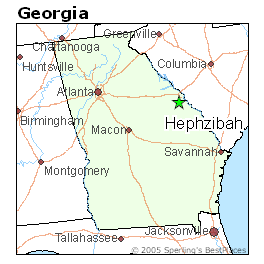
    So Many Towns and Cities in the Great State of Georgia: Hephzibah Edition

    The Great state of Georgia, according to Wikipedia, can lay claim to some 500+ incorporated cities and towns. When you factor in unincorporated towns, villages, and communities; that number easily eclipses 1,000. So many cool towns, and a lot of great names. There's Omega, Experiment, Good Hope, Sparta, Cairo, Athens, Ideal, Kingston, and so many others.

    One of my favs would have to be good ole Hephzibah, GA. Home of Georgia Bulldog Arthur Marshall. A great player for us back in the day, I understand he ran across some trouble a while back, but he's still a Dawg, even if he might not be in Damn Good Dog standing. But hey - everybody loves a comeback story.


    A fairly small town of about 4,500 residents, it's pretty close to Augusta and Columbia, SC and has at least a few amenities as I understand. Regardless, it's still got an awesome name.


    ---PHOTO COPIED FROM GOOGLE IMAGES--


    11 August 2014

    Such a Shame: A Sad Farewell to the Hancock Co. Courthouse

    As some of the regular readers of the Chronicles know, I have always been a huge fan of the courthouses of the great state of Georgia. As I mentioned in a previous write-up, the Hancock Co. courthouse, down in Sparta, was one of my all-time favs:

    "...perhaps one of the best looking courthouses in our state, especially in terms of the view as you approach it, would have to be down in Sparta, GA (Hancock Co.). That is a great courthouse. As I responded back to him, Hancock’s would probably be in my top 10 (maybe even top 5). Built between 1881-1883, it incorporates a Second Empire architectural design (the same as Covington) and is absolutely beautiful. Hancock Co. is an old county. It’s been around since 1793 which makes it a good bit older than Newton or Morgan, although not quite as old as the original 8 Georgia counties that were created in 1777. Hancock Co. and the city of Sparta, isn’t that far from us, just on the other side of Putnam Co."
    Well, sadly, at around 3AM this morning, the 130 year-old courthouse completely burned with only the exterior brick walls still standing. Man, what an absolute shame. Thoughts go out to the folks of Sparta and Hancock Co. That truly was a fine courthouse and due to its similarity to Newton County's, always held a special place in my heart. From my understanding, the two courthouses shared an architect. Probably the last time I saw it in person was about 10 years ago. Such a shame. Another piece of Georgia history gone forever...

    This seems like a tough blow for the city of Sparta and Hancock Co. One of the poorest counties in Georgia, it has experienced population loss and a dwindling tax base for some time. Again, my thoughts and prayers go out. You can read more about Hancock and the courthouse here.


    16 June 2014

    Past Piedmont Chronicles: The City of Covington


    The City of Covington
    *originally published in About Covington in 2009
     
    As I mentioned in a previous column, many folks refer to Covington as “C-town.” A friend of mine from Conyers once tried to tell me that Conyers is the original “C-town.” Well...for one thing, Covington is older, and with apologies to anybody who feels otherwise—Covington is the original C-town. Growing up in Covington during the 1980's was pretty cool. Buying G.I. Joe figures at Harper's, getting baseball cards at Leo's, and enjoying vanilla malts at City Pharmacy...it was a good time. The world seemed pretty small and Atlanta seemed like a million miles away. I imagine there are more than a few locals over the age of 40 or 50 who are probably getting a kick out me romantically reminiscing about Covington in the 80's. I'm sure they could tell you how it was in the 50's or 60's or earlier. And I'm sure it was great.

    Origins
    The city of Covington is the county seat of Newton County. For centuries, the Creek Indian nation had ownership of this area. Newton Co. would be made up of land ceded from the Creeks in 1805, 1818 and the treaty of Indian Springs in 1821. On December 24th, 1821—Newton Co. was formed through an act of the Georgia Legislature. The county was named for Revolutionary “war hero” John Newton.
    Questions actually exist as to whether or not Mr. Newton was real...his legend seems to come from the writings of M.L. Weems who was responsible for a lot of the romantic and fabricated tales of the early times of American history including the story of George Washington and the Cherry Tree. If Newton did indeed exist, it seems likely that he was not responsible for the act of heroism that he is credited with and there seems to be evidence that he was considered by some at the the time to be of questionable character and may have actually been referred to as a “thief and a villain.” So, the namesake of Newton Co. may have never existed at all or, if he did, was possibly considered a bit of a no-account.

    On April 15th, 1822, the Inferior court designated an area on a hill south of a swampy area by the Dried Indian Creek as the county seat and named it Newtonsborough. The story behind Dried Indian Creek goes like this—a corpse of an Indian was found on the bank of the creek and it was all dried up...it seems doubtful there was any truth to that story. Lots were laid out and sold in May of that year, and the town started to slowly grow. In December of 1822, the state legislature changed the name of the town in honor of Brig. General Leonard Covington who was killed in the War of 1812 and remembered as a hero. Unlike Newton, his legend seems to be legitimate.

    The War Between the States
    Covington's first direct contact with Union forces occurred in the Summer of 1864 when a cavalry division led by Kenner Garrard was instructed by William Sherman to destroy several of the railroads and bridges in and around Covington. He actually instructed Garrard to avoid any unnecessary molestation of private properties. On July 22nd, war broke out in Covington when an older resident named Presley Jones decided to take on the Yankees by himself. He did manage to kill two of them before he himself was shot and killed. Unfortunately, in order to placate their revenge, the Union forces court-martialed and executed a local man named George Daniel even though he was innocent of any crime.

    Despite numerous accounts to the contrary, there seems to be no evidence that Sherman knew anyone in Covington other than the sister of a man he went to West Point with. Actually, there is evidence that Sherman had given strict orders that personal homes were supposed to be off-limits. That only commercial, agricultural, and transportation-related properties were to be destroyed in addition to bridges, trains, and train tracks. Sherman and his troops would live off the land with the actual order being to “forage liberally on the country.” In fact, when Sherman had finally reached Covington himself in November of 1864, he told the Mayor that everything inside of people's houses was off-limits but everything outside was not. While the whole goal of the Georgia campaign was to make the South sick of war, it seems that more times than not, excesses seemed to occur on the flanks or well ahead or behind the main force. At times, the Union forces formed a swath 60-75 miles wide and were picking up stragglers and hangers-on all the while. The most egregious wrongs committed against locals seemed to happen more frequently on the periphery.

    After the Civil War, Covington had to deal with Reconstruction. Like the rest of the South, she struggled during that period, but would eventually come through it and grow and prosper.
    An interesting and little-known aspect of Covington's history was mentioned in my very first column. By the 1880's, Covington had become somewhat of a “wild west town” and had upwards of a dozen saloons and drinking establishments. Some of these included hotels and general stores, but several were just straight-up whiskey joints where cards could be played and various types of “entertainment” could be found. Liquor could also be bought by the bottle at general stores and druggist shops. The increasing influence of alcohol did start to cause some problems and by 1882, when a man named Will Smith killed two men after drinking and playing cards, the prohibition movement started to pick up some serious steam in Covington and Newton County.


    Covington would continue to thrive with the growth of the railroads and would enjoy prosperity for many years. Like every other town we've covered in these columns, the one-two punch of the boll weevil and the Depression were tough. But the town would survive and continue on a path of prosperity. During the 70's, the city would start to attract major industry and with the close proximity of I-20, the town has thrived for the last several decades. Covington is home and I love it. It's a wonderful place.

    I believe we have covered most of the towns and counties that this publication covers. So starting with the next column, I'm going to concentrate more on historical people and events rather that geographical areas. Next column, I'm going to write about the tragedy that occurred in 1921 when eleven peons were killed by John Williams.